The Theology of the French Reformed Churches: From Henry IV to the Revocation of the Edict of Nantes by Martin I. Klauber
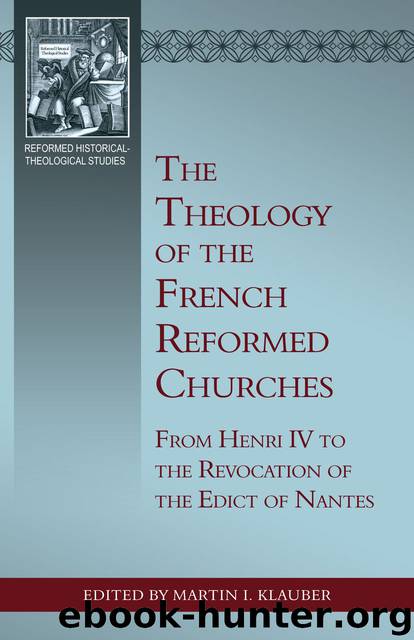
Author:Martin I. Klauber [Klauber, Martin I.]
Language: eng
Format: mobi
Tags: History
ISBN: 9781601783134
Publisher: Reformation Heritage Books
Published: 2014-09-22T04:00:00+00:00
Amyraut’s Theological Apologetics: Reason and Faith against Excess and Indifference
In one of the few studies of Amyraut’s thought that has examined its other dimensions, David Sabean identified his argumentation as leaning toward a form of theological rationalism and, as argued in general of Protestant orthodoxy by Hans Emil Weber, a precursor of the theological rationalism of the eighteenth and nineteenth centuries.54 This conclusion is fairly pointedly countered in Armstrong’s study, in which the “orthodox” are portrayed as rationalists, involved in metaphysical speculation and deductive logic and as giving large place to natural theology, while Amyraut is seen to be wary of metaphysics, consistently inductive in his logic, and seldom interested in or influenced by natural theology. Armstrong, in short, accepts Weber’s line of argument concerning Reformed orthodoxy and identifies Amyraut as a major exception, albeit still evidencing elements of some form of rationalism.55
Part of the reason for these diametrically different conclusions is that although both Sabean and Armstrong based their interpretations on a broad sampling of Amyraut’s writings, Armstrong framed his conclusions largely on what he took to be intentional “tensions” in Amyraut’s approach to hypothetical universalism, whereas Sabean argued the presence of rationalizing tendencies in the same arguments, indeed, of an approach designed to render the mysteries of predestination rationally comprehensible and concordant with “an a priori moral standard.”56 Sabean also looked more closely at Amyraut’s appeals to and use of reason in his apologetic works and, unlike Armstrong, did not rest his argumentation on assumptions concerning supposed inroads of metaphysics and natural theology into the Reformed doctrines of God and predestination. Rather, he pointed toward a “strong element of moral rationalism” that provided a basis for Amyraut’s argumentation and that in general, Amyraut “submitted all truths to the test of reason.”57 Arguably Amyraut’s approach lay somewhere in between. In major contrast to Armstrong’s view and with some significant modification of Sabean’s, Amyraut can be seen to stand in relative continuity with a long tradition that balanced the issues of faith and reason and accepted but limited the use of reason in theology, much in the manner of most Reformed orthodox writers of the era, albeit with a somewhat stronger appeal to reason in matters of faith.
Two of Amyraut’s works in particular illustrate his approach to the problem of faith and reason: his apologetic work against the Mass and transubstantiation, De l’élévation de la foy et de l’abaissement de la raison, and his apologetic for Christianity against the newly revived ancient philosophies of the era, the Traitté des religions. Amyraut’s premise in the first of these treatises is that although some of the fundamental truths of Christianity are and will remain incomprehensible—his example is the doctrine of the Trinity—it is also the case that, even given the limitation to the use of reason imposed by the fall into sin, true religion does not require the utter abandonment of rationality.58 Indeed, it is the abandonment of reason that Roman Catholic apologists have demanded in their attempt to justify acceptance of transubstantiation.
Download
This site does not store any files on its server. We only index and link to content provided by other sites. Please contact the content providers to delete copyright contents if any and email us, we'll remove relevant links or contents immediately.
The Lost Art of Listening by Michael P. Nichols(7509)
Why I Am Not A Calvinist by Dr. Peter S. Ruckman(4158)
The Rosicrucians by Christopher McIntosh(3523)
Wicca: a guide for the solitary practitioner by Scott Cunningham(3182)
Signature in the Cell: DNA and the Evidence for Intelligent Design by Stephen C. Meyer(3141)
Real Sex by Lauren F. Winner(3027)
The Holy Spirit by Billy Graham(2961)
To Light a Sacred Flame by Silver RavenWolf(2828)
The End of Faith by Sam Harris(2747)
The Gnostic Gospels by Pagels Elaine(2537)
Waking Up by Sam Harris(2465)
Nine Parts of Desire by Geraldine Brooks(2375)
Jesus by Paul Johnson(2366)
Devil, The by Almond Philip C(2339)
The God delusion by Richard Dawkins(2314)
Heavens on Earth by Michael Shermer(2286)
Kundalini by Gopi Krishna(2188)
Chosen by God by R. C. Sproul(2166)
The Nature of Consciousness by Rupert Spira(2110)
